Tesla’s Full Self-Driving gave me two experiences that are difficult to reconcile. It tried to steer me toward another car in a parking lot. It also spotted a kid on a scooter at night that I hadn’t seen at all.
Somewhere between those moments is the actual product: a remarkably capable driver-assistance system that can make an ordinary commute feel futuristic, right up until it needs you to take over.
I traded my Porsche for Colton’s Tesla with the intention of daily driving it for a month. He got my car, I got his FSD subscription, and we compared notes after a few weeks. The question wasn’t just whether it could handle turns and traffic lights. At 100 Canadian dollars a month during our test, did it take enough work off my plate to justify paying for it?
The answer is more complicated than I expected.
Key Takeaways
- FSD handled complex traffic impressively, but remained Level 2 assistance requiring continuous driver supervision.
- Parking, destination accuracy, camera visibility, and school-zone speed choices remained recurring weaknesses.
- Rare dangerous mistakes coexisted with a nighttime detection the supervising driver initially missed.
- At 100 Canadian dollars monthly, reduced driving effort didn’t justify the subscription for either driver.
First, “Full Self-Driving” Still Means You’re the Driver
Despite the name, the system I tested was Level 2 driver assistance, not autonomous driving. It could steer, accelerate, brake, navigate intersections, and do considerably more than a typical lane-centering system. But I still had to supervise it and be ready to take control at a moment’s notice.
That distinction matters because, under the right conditions, it does a very convincing impression of a car that doesn’t need you.
My plan was to record every drive, including the road, the screen, and what was happening inside the car. The recording setup didn’t cooperate for the entire test, so some footage was missing. This was a daily-use experiment, not a controlled safety study or a complete statistical record of every mile.
It also got off to a hilarious start. On the first trip to our tech house, the driveway was blocked, and the Tesla delivered me to a different house and decided its job was finished.
Excellent. We had already established that getting somewhere and getting to the right place were separate features.
Day One: Construction, a Great Merge, and One Very Bad Parking Lot
The first drive home took a different route than I normally use, straight through a proper construction zone. Not a couple of cones beside an otherwise normal road. Temporary lanes, altered markings, and enough going on to make this an interesting first test.
The Tesla stopped roughly a car length and a half behind the stop line. Predictably, another driver filled the space. That meant I didn’t get the clean test I wanted of the Tesla leading the way through the construction, since it now had another car to follow.
Still, its handling of the area was impressive. The live visualization picked up temporary road markings, including directional arrows, and the eventual merge was about as smooth as I could have asked for.
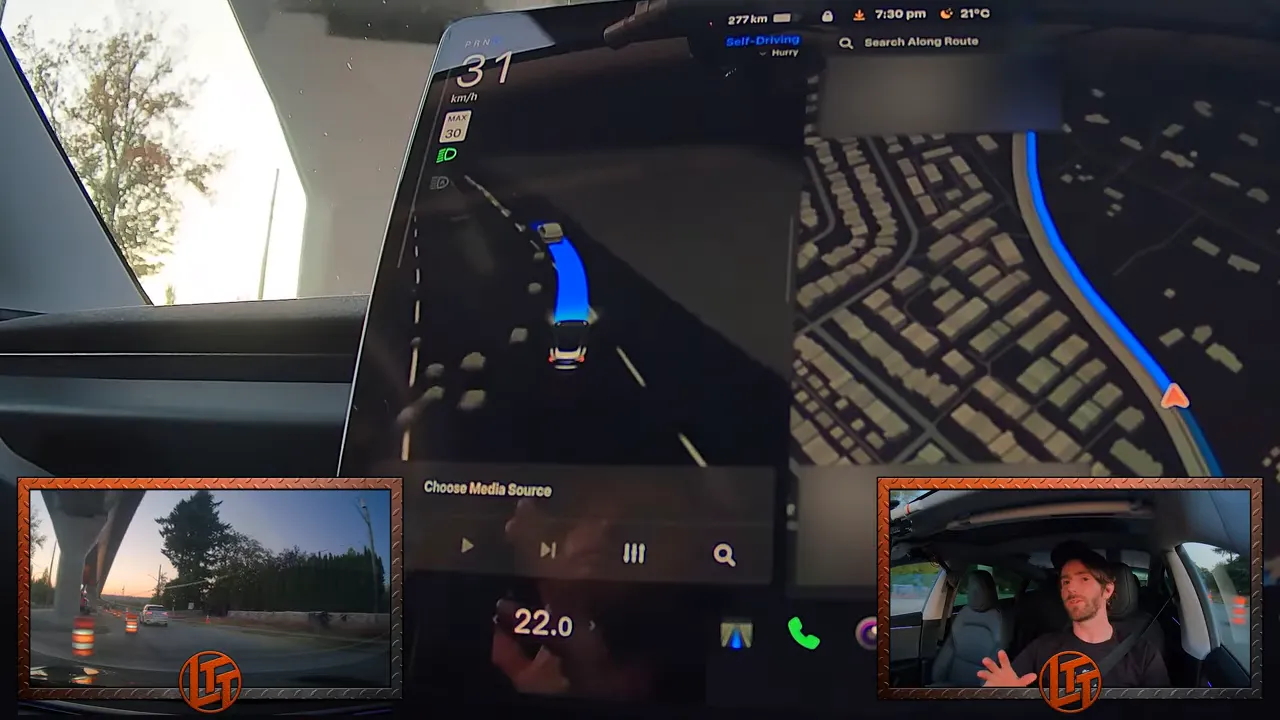
I was nearly ready to call the first day a success without any major interventions. It was easy to understand how someone could become overconfident. Most of the time, you selected a destination, and the car just took you there.
Then, later that night, it attempted a parking-lot maneuver that looked like it was going to put us into another car. I took over.
There went the intervention-free first day. More importantly, there was the central problem with this entire experience: a long stretch of competent driving does not remove the need to supervise the next maneuver.
The Good Part: It Often Handles Real Traffic Beautifully
Taking a carload of coworkers to lunch was a useful reality check. Some had experienced FSD before; others hadn’t. The initial nervous joking gradually gave way to genuine appreciation of how much it was doing correctly.
It came to full stops at stop signs. It handled ordinary street traffic, bends, parked vehicles, and people near the road. Sometimes its acceleration felt more enthusiastic than I wanted, but the general smoothness was better than the nervous first impressions suggested.
Over the following days, several moments stood out:
- A busy four-way stop: It dealt with other vehicles and the order of right of way, rather than simply stopping at an empty intersection and proceeding.
- A bus pulling away from a stop: In a situation where the bus had priority, it reacted to the signal and made room before the bus became an obstacle directly ahead.
- Uncertain road users: It waited while another person’s intentions became clear instead of immediately forcing the situation.
- A pedestrian entering a crosswalk: It was preparing to go, noticed someone stepping into the street, stopped, and waited until the crossing was clear.
- People approaching potential danger: On another drive, it slowed gently for someone whose trajectory could have put them in our path.
These weren’t all dramatic emergency-braking events. Some of the most impressive moments were the subtle ones, where its response looked very close to what I would have done.
It could stop somewhere sensible behind an obstruction, wait, and get back up to speed once the way was clear. It could move around a vehicle gracefully. It often handled cones, construction, and people beside the road with more confidence than I expected.
Eventually, I completed two drives to and from Richmond, each more than 45 minutes long, without interruption. That is genuinely impressive. Most days, there simply wasn’t a spectacular failure to report.
The Last Few Metres Were Much Less Convincing
Driving across town and finishing the trip properly turned out to be very different challenges.
The lunch trip ended with the Tesla circulating through a confusing parking lot. It passed available spaces, left the area we wanted, and committed to another loop. Eventually, I had enough. I do not have unlimited lunch.
To be fair, it did complete a parking maneuver elsewhere. Parking wasn’t something it categorically couldn’t do. It was something I couldn’t count on it to finish sensibly in every location.
At our buildings, it sometimes failed to choose one of our designated spaces. On another trip, it decided that a position which would block other cars was a suitable place to stop.
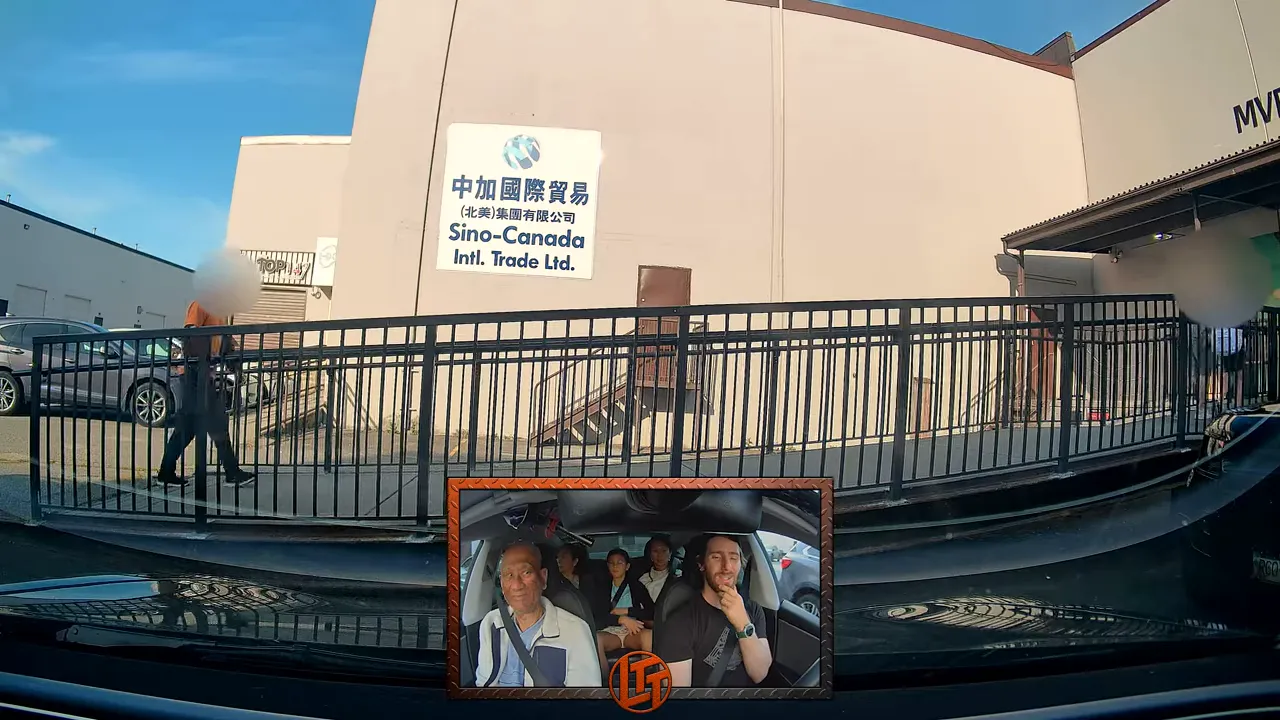
And the neighbor’s driveway at the tech house became a repeat destination. Apparently, that was where the Tesla thought I lived now.
I caught myself being annoyed that I had to park manually, like some kind of caveman. Which is ridiculous, but also revealing. The rest of the drive often worked well enough that handling the final bit myself started feeling like an inconvenience.
Navigation Mistakes Aren’t Always Safety Mistakes
One particularly frustrating drive involved a freeway entrance and a nearby exit. The Tesla chose the wrong route and took me on an unwanted trip over a bridge.
It didn’t do anything unsafe in that instance. It also didn’t do anything I haven’t seen a human driver do. It simply committed to the wrong option, and I got a detour.
That is worth separating from a critical intervention. Throughout the test, there were several different kinds of shortcomings:
- Destination and route errors: Going to the wrong driveway or taking the wrong branch of an interchange.
- Convenience interventions: Nudging it with the accelerator when it failed to take a valid right-turn arrow.
- Availability problems: Refusing to engage when the cameras reported visibility trouble.
- Safety-critical mistakes: Maneuvers where I felt I needed to take over to avoid a dangerous outcome.
Lumping all of those together would hide important differences. An unnecessary bridge crossing is irritating. A bad move into an intersection is something else entirely.
I also noticed the navigation beginning to use a shortcut I liked after I had manually taken it a couple of times. That was neat, but the observation alone wasn’t proof that FSD had learned my preference. Meanwhile, software updates continued arriving, and the notes discussed further work on parking behavior, including preferences related to driveway orientation and charging access.
Sunshine Could Stop It. Heavy Rain Didn’t Necessarily.
After an otherwise smooth outing, FSD refused to start driving. The screen reported that multiple cameras were blocked or blinded and needed cleaning.
The windshield looked clean. My suspicion was that harsh sunlight was hitting the front camera at an unfortunate angle. Once the condition passed, the system became available again.
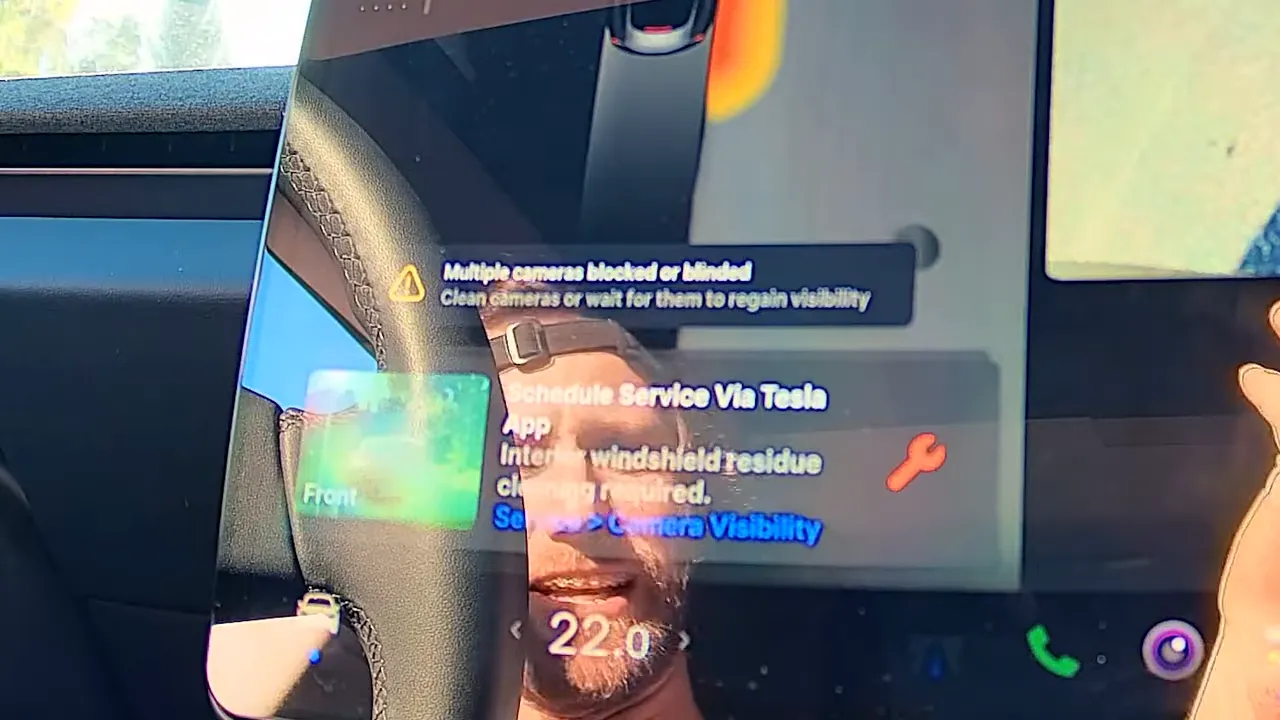
I counted that as an interruption, even though it was a refusal to engage rather than a disengagement during a drive. A system that can’t begin the trip still isn’t doing the driving for you.
It was also a practical reminder of the limitations of a camera-only approach. Not every visibility problem is dirt you can wipe off.
Heavy rain was surprisingly less disruptive in my experience. I drove through some substantial rain, and FSD continued operating. It did present reduced-visibility warnings in conditions such as rain and fog, but it didn’t automatically become unusable every time the weather turned bad.
Camera cleanliness still mattered. We also discussed cleaning the area behind the camera cover. That space wasn’t sealed against contamination, although it was accessible for cleaning. Colton had already received prompts about it before handing over the car.
None of this made me like the automatic windshield wipers, by the way. That complaint survived the experiment just fine.
Speed Selection Was One of My Biggest Complaints
FSD’s willingness to go with the flow of traffic could be unsettling. On one drive, I noted that we were doing about 112 km/h where a 50 km/h limit was indicated, while keeping pace with surrounding vehicles.
We speculated about how much it was using the speed of the car ahead to decide its own pace. But speculation about its logic doesn’t solve the practical issue: I needed to monitor its speed choices.
My recurring concern was its behavior in school zones. It did not reliably adhere to the reduced limits the way I wanted it to.
I might normally prefer a more assertive driving profile, such as Hurry or Mad Max. That does not mean I want the same attitude applied everywhere. I specifically want strict speed-limit compliance in school zones, playground zones, and construction zones.
Colton pointed out that the car could update its displayed understanding of the speed limit. Recognizing a limit and choosing a speed I considered appropriate were not always the same thing.
The driving profiles themselves also made a difference to how the car felt. Mad Max was aggressive enough that we discussed backing down to Hurry. General smoothness was often good, but not consistently enough that I’d describe every acceleration or braking event as polished.
The Worst Intervention, and the Best Save
Late in the test, the Tesla attempted a turn from a lane that wasn’t a turning lane. Instead of stopping and waiting for a suitable opening, it committed to the maneuver.
Another driver closed the gap rather than letting us in, and I ended up stuck in the intersection trying to deal with the situation. That was probably the worst intervention of the test.
There were smaller questions about consistency, too. The Tesla identified a squirrel as an animal and slowed, but I still pressed the brake to make sure we wouldn’t run over it. I remembered another animal encounter where its response had been different. A software update had happened between those events, so I couldn’t confidently explain why.
Then came the moment that pulled me in the opposite direction.
At night, approaching a green light, the car slowed for what initially looked like no reason. I was confused enough to wonder whether I should encourage it to continue.
There was a kid on a scooter, dressed in dark clothing without reflective gear. I hadn’t seen them, even as the car began reacting.
I can’t prove what would have happened had I been driving manually. But it was a potentially life-saving detection, and it deserved credit.
By the end, I could count the genuinely critical interventions on one hand. In the discussion with Colton, my rough estimate was perhaps two dangerous interventions, alongside that one particularly important save. Those were personal assessments, not a formal safety score. The save doesn’t cancel out a mistake, and the mistakes don’t make the save any less impressive.
Hands-Free Is Not Attention-Free
The Tesla monitored where I was looking and where my hands were. At one point, it disabled hands-free operation because it apparently didn’t think my hands were positioned to take over quickly enough. It required contact with the wheel, then restored hands-free operation after I adjusted my posture.
Generally, looking toward the road was enough to avoid frequent attention prompts. That made the system less annoying, but I wasn’t convinced that the monitoring always demanded the level of readiness the driving actually required.
On our final drive, I also encouraged Colton to become familiar with taking control before he needed to do it urgently. The steering resistance and the transition back to manual control could feel more forceful than expected.
The important point wasn’t finding a comfortable pose that satisfied the camera. It was remaining capable of responding immediately. My foot stayed ready to intervene without resting on a pedal and unintentionally affecting the system.
That creates an awkward mental state. You’re doing less of the physical driving, but you still own the consequences of anything it gets wrong.
Meanwhile, Colton Had Opinions About My Porsche
The car swap also reinforced that FSD and the Tesla itself are two different reviews.
My favorite thing about the Tesla was easily the driver assistance. Actually driving it manually was much less appealing to me. I still disliked the pedal response, and its strong one-pedal behavior felt like something I had to micromanage rather than a convenience.
Colton appreciated how well the Porsche handled. If you enjoy driving, that was the clear win. He also liked its smoother-feeling regenerative braking behavior. In the configuration we discussed, it offered some deceleration resembling engine braking, with a blend between regeneration and physical braking that I think Porsche does very well.
But he had complaints:
- The backup camera was awful in his estimation. Unfortunately, it wasn’t malfunctioning. That was just how it looked.
- The key-fob battery was already weak, making starting the car unnecessarily annoying.
- He missed not having to carry a key, something both of us appreciated about the Tesla.
- The Porsche attracted more judgmental looks than he expected, possibly helped along by its wrap.
I had also discovered an apparent cellular signal-boosting feature associated with the phone sleeve in the armrest, although neither of us had tested it during the swap.
And then there was the Tesla’s overpowering vanilla smell. Multiple passengers had complained about nausea; I found it headache-inducing. Colton thought he had removed the air freshener. It turned out there were three.
Three. That explained a lot.
Is Tesla Full Self-Driving Worth 100 Canadian Dollars a Month?
At the end of the test, I was far more impressed with FSD’s capability than I expected to be. Colton also found it significantly better and more confident than when he had tried it a few years earlier. Road debris, which had previously concerned him, was generally handled well during my use, with only an occasional hesitation.
But capability and value are not the same thing.
At the tested subscription price, you’re spending 1,200 Canadian dollars a year for assistance that still requires continuous supervision. It did reduce some of the mental load. After a tiring day at work, having the car handle the steering, braking, and route execution was somewhat more relaxing.
Just not as relaxing as I wanted it to be.
The closest comparison is being on call for work. You might not actively be working, but you can’t fully switch off or commit your attention to something else. You’re waiting for the moment when you might suddenly be needed.
Colton, with his longer commute, came to a similar place. He felt comfortable with the system’s performance, but the monthly price was still high for what it let him do. Around 50 Canadian dollars or less might have been more tempting, and even then he wasn’t certain.
We agreed that the value calculation would change dramatically if a future system were genuinely capable of unsupervised operation and legally permitted us to use that commuting time for something else. In that situation, even a much higher price could make sense. That would require more than a change in legislation, though. The technical capability and approval would need to be there too.
That isn’t the product I tested.
My verdict: Tesla Full Self-Driving is an impressive driver-assistance system, but I wouldn’t personally pay the tested subscription price while it still requires this much alertness. It gave me long stretches of effortless-feeling travel, a handful of serious reminders to stay ready, and one moment where it detected someone I missed.
I could practically smell the future. Once we removed the vanilla, anyway. I’m just not ready to pay as though that future has already arrived.


